
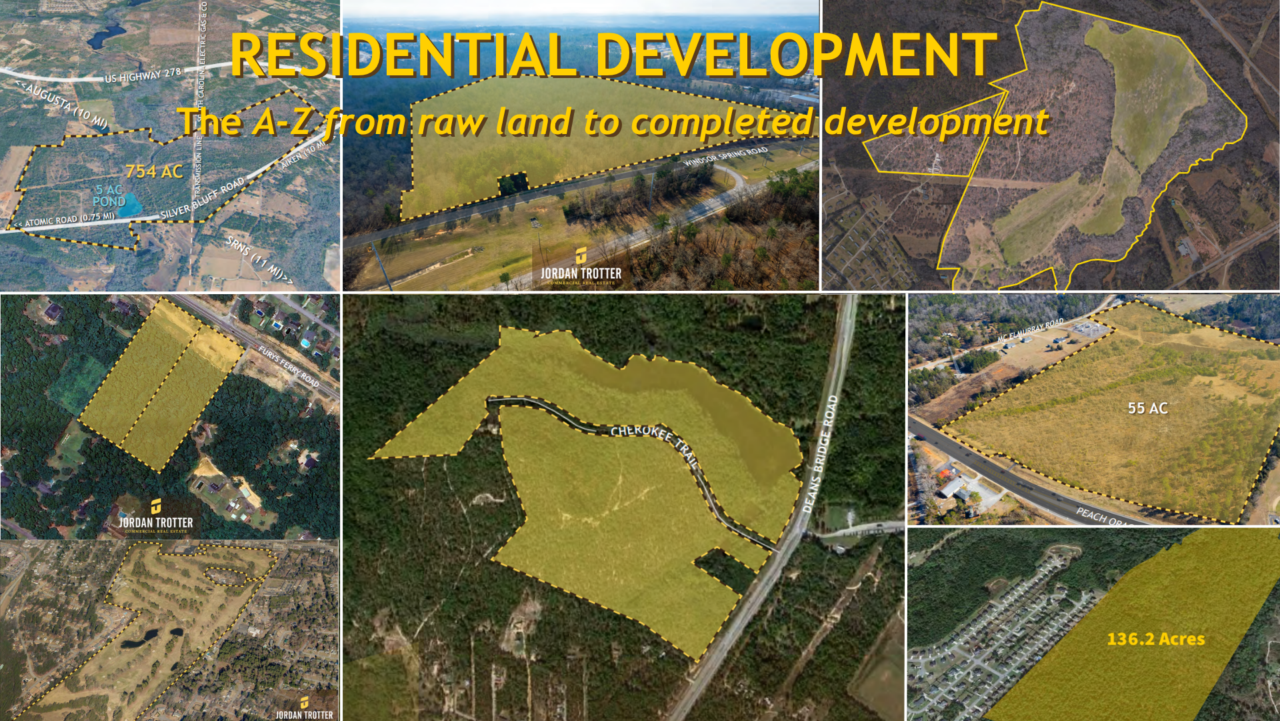
Building the Future: How Residential Development Takes Shape in the CSRA
Building the Future: How Residential Development Takes Shape in the CSRA
Across the Central Savannah River Area growth is no longer a question of if, it’s a matter of how thoughtfully and efficiently new housing can be delivered. As population trends shift and demand for quality housing continues to rise, commercial real estate firms play a critical but often unseen role. We shape the communities where people will live, work, and raise families.
At our company, we are proud to be part of that process. We help bring new residential developments to life from the earliest stages of land positioning to the moment construction begins. While many people see the finished product, a neighborhood filled with homes, sidewalks, and families, the real story starts long before the first shovel hits the ground.
Every successful residential development begins with a tract of land and a vision. When we list a residential development site, our role extends far beyond simply marketing acreage. We evaluate the property’s highest and best use. We consider location, surrounding growth patterns, access to infrastructure, school districts, and long-term regional planning. We work closely with landowners to position the property in a way that attracts qualified developers. The goal is to execute a project that fits the market and the community.
At this stage, we are not just selling land, we are helping shape future neighborhoods. From a commercial real estate perspective, our agents serve as a connector, strategist, and guide throughout the process.
Our responsibilities include:
- Identifying and qualifying developers with the right experience and financial capacity
- Providing market data to support pricing, density, and product type
- Coordinating due diligence materials for prospective buyers
- Navigating negotiations between buyer and seller
- Anticipating development challenges before they arise
We often act as the first filter. We ensure that the land and the developer are aligned in terms of vision and feasibility.
Once the property is under contract, the process becomes significantly more complex. Developers work alongside the commercial real estate agent to take on the responsibility of transforming raw land into a buildable, functional, and desirable community. This involves assembling a team of engineers, planners, attorneys, and consultants to evaluate every aspect of the property.
Their work includes:
- Designing site layouts and lot configurations
- Conducting environmental and topographical studies
- Coordinating with municipalities and utility providers
- Securing financing for land acquisition and development
One of the most misunderstood aspects of residential development is the timeline. From contract to construction, the process can take anywhere from 6 months to several years depending on complexity.
Here’s a simplified look at the typical checklist:
1. Due Diligence Period
Survey and title review
Environmental studies (Phase I, wetlands, etc.)
Soil and geotechnical testing
Initial concept planning
2. Zoning & Entitlements
Rezoning applications (if needed)
Subdivision approvals
Density and land-use approvals
Planning commission and council hearings
3. Infrastructure & Utilities
Sewer access and capacity verification
Water availability
Stormwater management planning
Power, gas, and telecom coordination
4. Easements & Access
Road access and traffic studies
Easement negotiations (ingress/egress, utilities)
DOT approvals if required
5. Engineering & Final Approvals
Civil engineering plans
Permitting
Final plat approvals
Only after these steps are completed can development truly begin.
One of the most important, and sometimes most sensitive parts of the process is engaging with the surrounding community. Before a project moves forward, developers and agents often participate in neighborhood meetings with nearby homeowners.
These meetings serve several key purposes:
- Providing transparency about the proposed development
- Answering questions about traffic, density, and property impact
- Gathering feedback that can improve the project
- Addressing concerns and reducing uncertainty
Growth can make some people feel anxious, especially those who have lived in an area for many years. By opening lines of communication early, we help build trust and create developments that better reflect the needs of the broader community. By the time construction equipment arrives on-site, an extraordinary amount of work has already taken place and much of it is behind the scenes.
From coordinating with municipalities to navigating regulatory hurdles, aligning stakeholders, and solving unforeseen challenges, the process requires patience, expertise, and collaboration.
As commercial real estate professionals, we are involved at the very beginning. We help set the stage for developments that will shape the CSRA for generations to come.
Residential development is more than building homes. It’s about creating communities, supporting economic growth, and accommodating the future of our region. Our role, alongside dedicated developers and community partners, is to ensure that growth happens in a way that is strategic, sustainable, and beneficial for everyone involved.
The next time you pass a new neighborhood under construction, it’s worth remembering that project represents years of planning, partnership, and perseverance, all working together to bring new life and opportunity to the CSRA.
- FILED UNDER:
- Uncategorized